• Skip to main content
  • Skip to footer

re-think.nu

  • About
    • Film
    • About Us
    • We are ReThink
    • Blog
      • Categories
        • Textile production
        • Textile consumption
        • Textile Recycling
        • Biodiversity
        • Earth’s resources
        • The Earth Spheres
        • Water
        • Organic
        • Chemicals
        • ReThink – Think Again
    • Tips
    • Links & Sources
      • Links
      • Textile Sources
      • Small Animals Sources
      • Plant Sources
      • Fungi Sources
  • TEXTILES
    • Textile Knowledge
    • Textile Recycling
    • Textile Dictionary
    • Rethink Fabric – Series
    • Fact Sheets
  • BIODIVERSITY
    • Small Animals
      • Small Animals Knowledge
      • Small Animals Dictionary
      • Small Animals Series
      • Small Animals Films
    • Plants
      • Plant Knowledge
      • Plant Dictionary
      • Think About Plants – The Spruce Tale
      • Films About Plants
    • Fungi
      • Fungi Knowledge
      • Fungi Dictionary
      • Fungi Film
      • ReThink Fungi
    • Microorganisms
  • Earth
    • Earth’s Spheres
    • Ecosystem – Biosphere
    • Resource Extraction – Industry
    • Earth Dictionary
  • DICTIONARY
  • CONTACT
    • Press
    • Support Us
    • Become a Member
    • Privacy policy
    • Donations & sponsorship
    • Collaborations
      • SIDA
      • Nature Conservation Society
      • Fabric to Fabric
      • Keep Sweden Clean
      • University of Linköping
  • Swedish
  • Instagram
  • Facebook
  • Youtube
  • Linkedin

Phloem

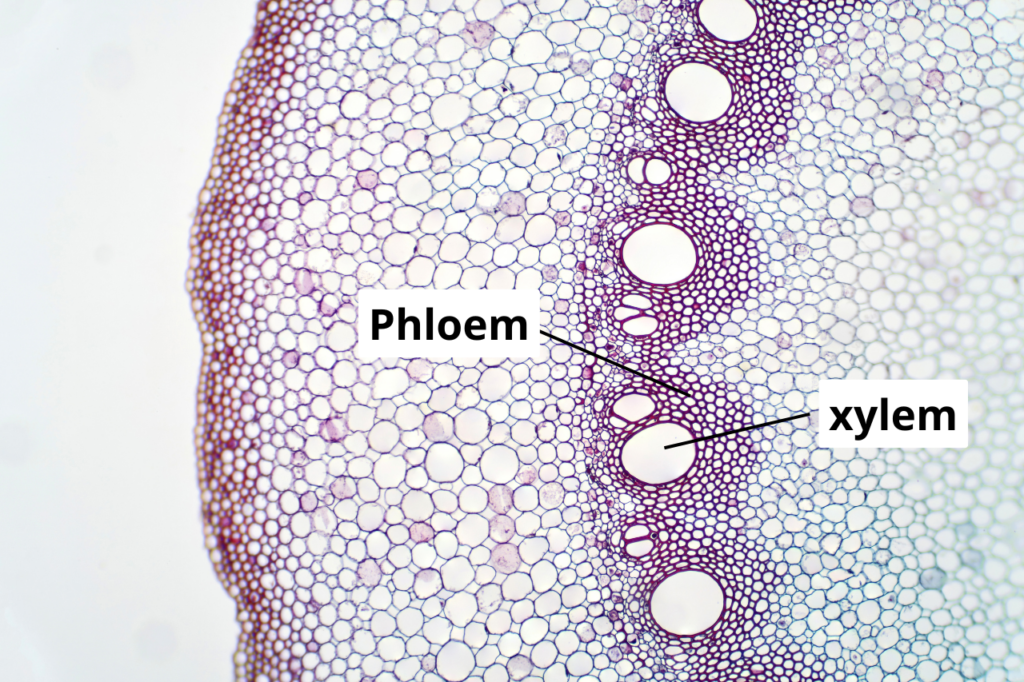
There are two types of vascular tissue inside the stem of vascular plants: xylem and phloem, which act as the plant’s transport system.

The phloem consists of living cells and is sometimes also referred to as sieve tissue. This is where sugars, amino acids and other organic substances are transported to and from the leaves. In spring, starch rises from the roots up to the leaves and is converted into sugar (glucose). In autumn, the flow of sugar goes in the opposite direction and is stored once again in the roots as starch.
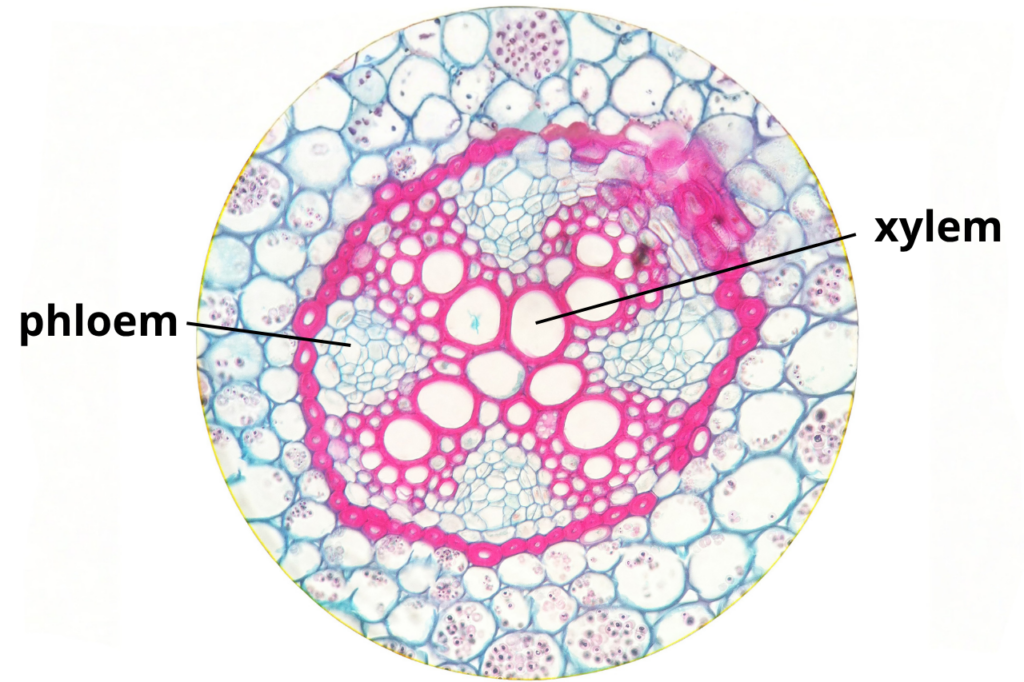
Cross-section of a stem in a dicotyledonous plant.
crochet alike cell drawing with holes in the middle and names phloem and Zylem. Light grey background and purple greyish network.
Xylem and phloem in the stem of a monocotyledonous plant.

The xylem and phloem look slightly different depending on the type of plant. Flowering plants, for example, are divided into monocots (e.g. grasses and lilies) and dicots (e.g. deciduous trees and cotton plants) based on the number of leaves that develop from the first sprout.

Links

ReThink – Plants Knowledge
Magnus Ehingers Education – The stem and the transportation chanel

Maj 2026, TÄNKOM | Revised August 2026, RETHINK

Footer

  • Blog
  • ABOUT
  • Global Goals
  • Collaborations
  • About Us
  • Press
  • Instagram
  • Facebook
  • Youtube
  • Linkedin

Partly financed by

© re-think.nu | 2026

Copyright © 2026 · Atmosphere Pro on Genesis Framework · WordPress · Log in