• Skip to main content
  • Skip to footer

re-think.nu

  • About
    • Film
    • About Us
    • We are ReThink
    • Blog
      • Categories
        • Textile production
        • Textile consumption
        • Textile Recycling
        • Biodiversity & Ecosystem
        • Natural Resources
        • The Earth Spheres
        • Water
        • Organic
        • Chemicals
        • ReThink – Think Again
    • Tips
    • Links & Sources
      • Links
      • Textile Sources
      • Small Animals Sources
      • Plant Sources
      • Fungi Sources
  • TEXTILES
    • Textile Knowledge
    • Textile Recycling
    • Textile Dictionary
    • Rethink Fabric – Series
    • Fact Sheets
  • BIODIVERSITY
    • Small Animals
      • Small Animals Knowledge
      • Small Animals Dictionary
      • Small Animals Series
      • Small Animals Films
    • Plants
      • Plant Knowledge
      • Plant Dictionary
      • Think About Plants – The Spruce Tale
      • Films About Plants
    • Fungi
      • Fungi Knowledge
      • Fungi Dictionary
      • Fungi Film
      • ReThink Fungi
    • Microorganisms
  • Earth
    • Earth’s Spheres
    • Ecosystem – Biosphere
    • Resource Extraction – Industry
    • Earth Dictionary
  • DICTIONARY
  • CONTACT
    • Press
    • Support Us
    • Become a Member
    • Privacy policy
    • Donations & sponsorship
    • Collaborations
      • SIDA
      • Nature Conservation Society
      • Fabric to Fabric
      • Keep Sweden Clean
      • University of Linköping
  • Swedish
  • Instagram
  • Facebook
  • Youtube
  • Linkedin

Spider (Araneae)

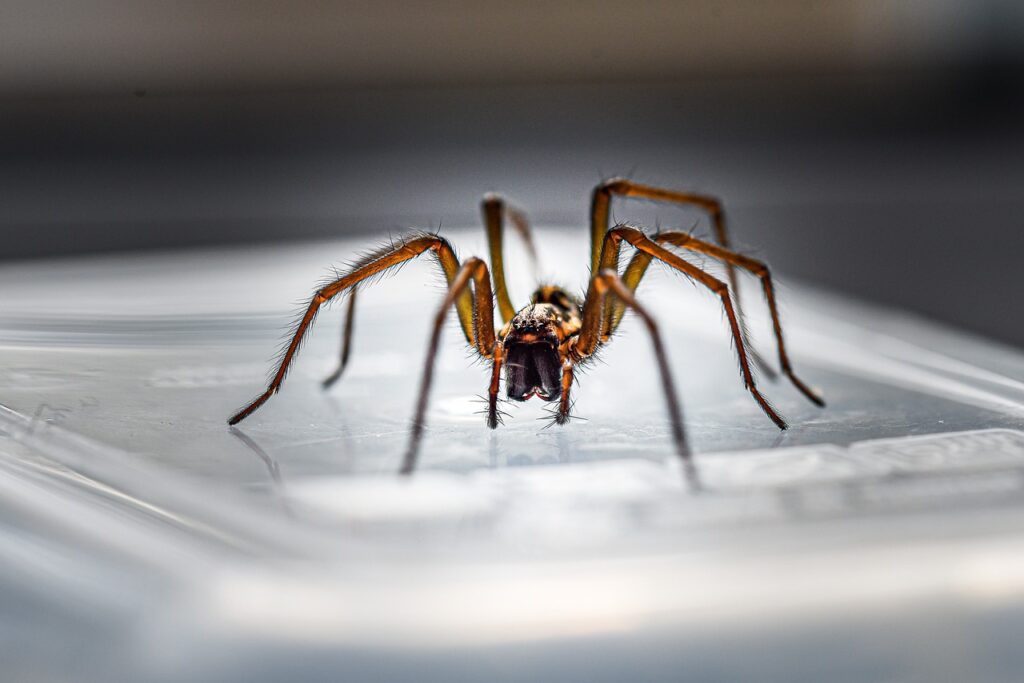
Brown colored skinny hairy spider  on a glass plate. Grey glassy background and dark grey background over the plate

Spiders belong to the class of arachnids, a class of arthropods that also includes scorpions, mites and ticks. Most spider species have eight eyes, although some have six. Despite all these eyes, many do not see very well. Spiders vary in size, ranging from the most petite, 0.03 cm long, to a tarantula with a leg span of almost 30 cm [1].

Most spider species are predators, either catching flies and other insects in their webs or hunting them. However, they cannot swallow their food as they are. Spiders inject their prey with digestive fluids and then suck out the liquid remains [2].

Not all spiders build webs, but every species produces silk. They use robust and flexible protein fibres for many different purposes: climbing, as a safety line, creating egg sacs, wrapping prey, making nests and more. Spider silk is also used by humans, traditionally to construct webs and clothing [2].

Spiders play a fundamental role in natural ecosystems, feeding many insectivorous animals. Many vertebrates feed almost exclusively on spiders alone. Birds eat spiders, and many use spider silk to bind their nests [1, 2, 3].

Key functions

● Controls insect populations

● Trapping insect pests

● Food for other animals

Threat

● Loss of habitats

● Pet trade (certain species)

Common species

More than 45,000 known species of spiders are found in habitats worldwide [1]. Sweden has about 730 spider species, but none are dangerous to humans [5].

Some species to discover in nature:

● Garden Spider (Araneus diadematus)
Naturespot – Garden Spider “”””

● Raft Spider (Dolomedes fimbriatus)
iNaturalist – Raft Spider “”””

● Större husspindel
Wikipdia – Giant House Spider “”””

● Rabbit Hutch Spider (Steatoda bipunctata)
Naturespot – Rabbit Hutch Spider “”””

Sources

  1. Minax Tarantulas – Spiders 
  2. Wikipedia – Spiders 
  3. Lunds universitet – Spiders eat more insects than humans eat mea 
  4. Anticimex – Which spiders are found in Sweden? 
  5. Stick.se – Avoid spiders in the house 

June 2023, TÄNKOM | Revised February 2024 RETHINK

Footer

  • Blog
  • ABOUT
  • Global Goals
  • Collaborations
  • About Us
  • Press
  • Instagram
  • Facebook
  • Youtube
  • Linkedin

Partly financed by

© re-think.nu | 2026

Copyright © 2026 · Atmosphere Pro on Genesis Framework · WordPress · Log in