• Skip to main content
  • Skip to footer

re-think.nu

  • About
    • Film
    • About Us
    • We are ReThink
    • Blog
      • Categories
        • Textile production
        • Textile consumption
        • Textile Recycling
        • Biodiversity
        • Earth’s resources
        • The Earth Spheres
        • Water
        • Organic
        • Chemicals
        • ReThink – Think Again
    • Tips
    • Links & Sources
      • Links
      • Textile Sources
      • Small Animals Sources
      • Plant Sources
      • Fungi Sources
  • TEXTILES
    • Textile Knowledge
    • Textile Recycling
    • Textile Dictionary
    • Rethink Fabric – Series
    • Fact Sheets
  • BIODIVERSITY
    • Small Animals
      • Small Animals Knowledge
      • Small Animals Dictionary
      • Small Animals Series
      • Small Animals Films
    • Plants
      • Plant Knowledge
      • Plant Dictionary
      • Think About Plants – The Spruce Tale
      • Films About Plants
    • Fungi
      • Fungi Knowledge
      • Fungi Dictionary
      • Fungi Film
      • ReThink Fungi
    • Microorganisms
  • Earth
    • Earth’s Spheres
    • Ecosystem – Biosphere
    • Resource Extraction – Industry
    • Earth Dictionary
  • DICTIONARY
  • CONTACT
    • Press
    • Support Us
    • Become a Member
    • Privacy policy
    • Donations & sponsorship
    • Collaborations
      • SIDA
      • Nature Conservation Society
      • Fabric to Fabric
      • Keep Sweden Clean
      • University of Linköping
  • Swedish
  • Instagram
  • Facebook
  • Youtube
  • Linkedin

Plant Parts

Vascular plants can vary greatly in shape and size, but they nevertheless follow a common morphology pattern, which refers specifically to their shape and structure.
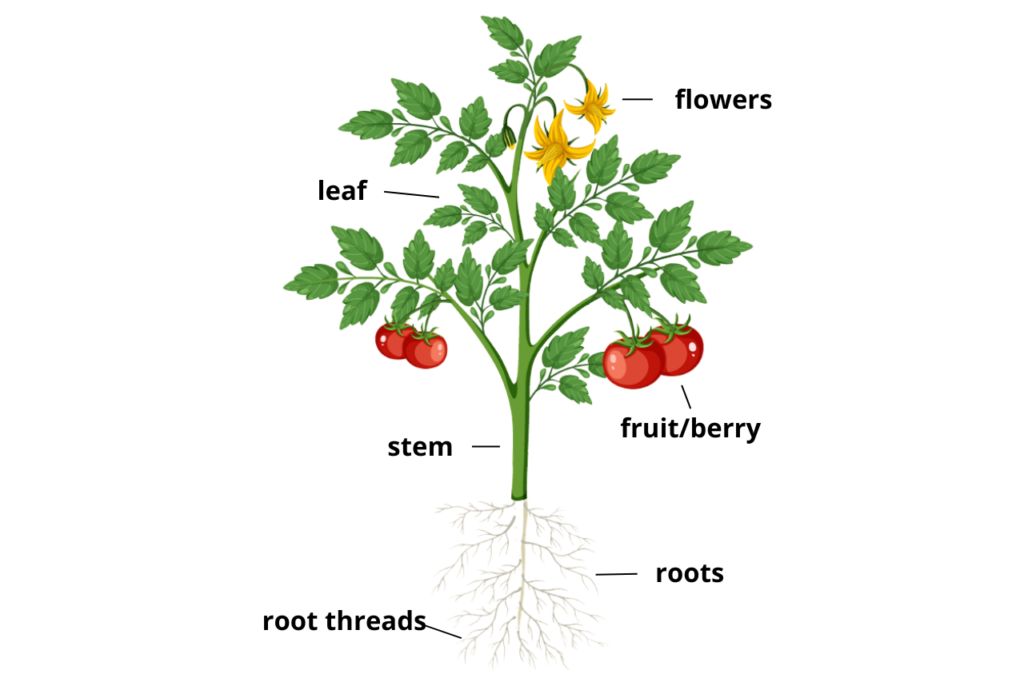
diagram drawing of tomato plant with yelow flowers, green leaves and two small red tomatoes on the left and right bottom of the plant. Roots are illustrated with yellow grey pensil
In everyday language, the tomato is considered a vegetable, but in botanical terms it is a fruit – or, more precisely, a berry.

The roots anchor the plant to the ground, absorb water and nutrients through root hairs, and store energy in the form of starch.

The stem acts as the plant’s transport system and keeps the plant upright. It carries water and minerals up to the leaves and transports sugars and energy back down to the rest of the plant. Inside the stem, there are two types of vascular tissue: xylem and phloem.

The xylem consists of dead, hollow cells that form tubes. This is where water and minerals are transported from the roots up to the leaves; it is this tissue that forms the wood in trees and shrubs.

The phloem, also known as sieve tissue, consists of living cells that transport sugars, amino acids and other organic substances to and from the leaves, depending on the season.

The leaves are responsible for photosynthesis, a process in which sunlight is captured, and carbon dioxide and water are converted into glucose and oxygen. Stomata on the underside of the leaves regulate how much carbon dioxide and water vapour are taken in and released.
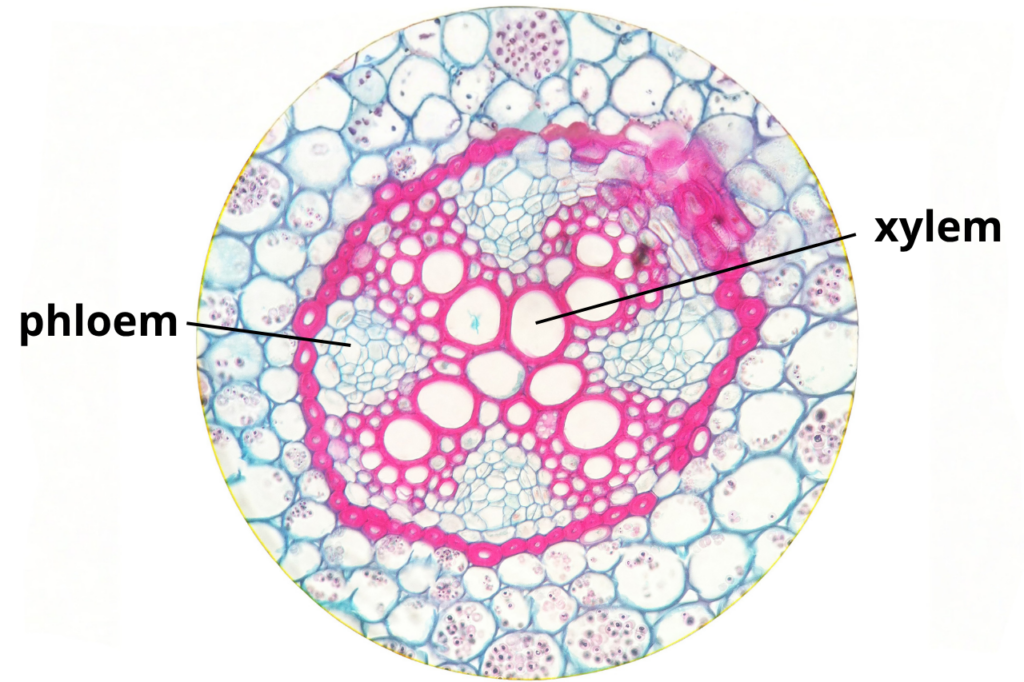
Cross-section of a vascular plant’s stem diagram. Phloem and xylem bluish bubles with pink cross shape in circle showing bubble cells on white background
Cross-section of a vascular plant’s stem
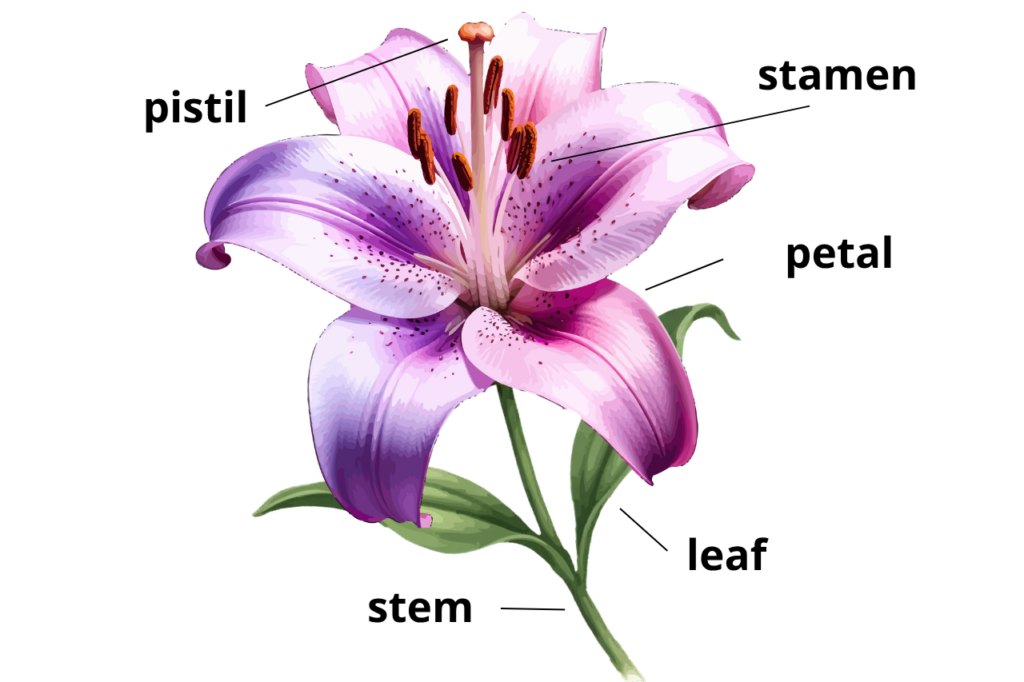
Flower part diagram drawing with a purple violet flower, stamen, pistil, green leaves
The different parts of a flower

Flowers are the reproductive organs of a plant. They consist, amongst other things, of petals, stamens and a pistil. The petals are often brightly coloured or fragrant to attract pollinators.

The stamens are the male reproductive organs of the plant and produce pollen, whilst the pistil is the female reproductive organ where the ovule is found. When pollen is transferred from the stamen to the pistil, pollination takes place. Seeds then form, and often a fruit or berry develops to protect them; these seeds are later dispersed and can germinate to become new plants.

Links

ReThink – Plant Knowledge
Impecta Seed Shop– Pollination – a seed is created
Oregon State University – Reproductive plant parts

April 2026, TÄNKOM | Revised July 2026, RETHINK

Footer

  • Blog
  • ABOUT
  • Global Goals
  • Collaborations
  • About Us
  • Press
  • Instagram
  • Facebook
  • Youtube
  • Linkedin

Partly financed by

© re-think.nu | 2026

Copyright © 2026 · Atmosphere Pro on Genesis Framework · WordPress · Log in